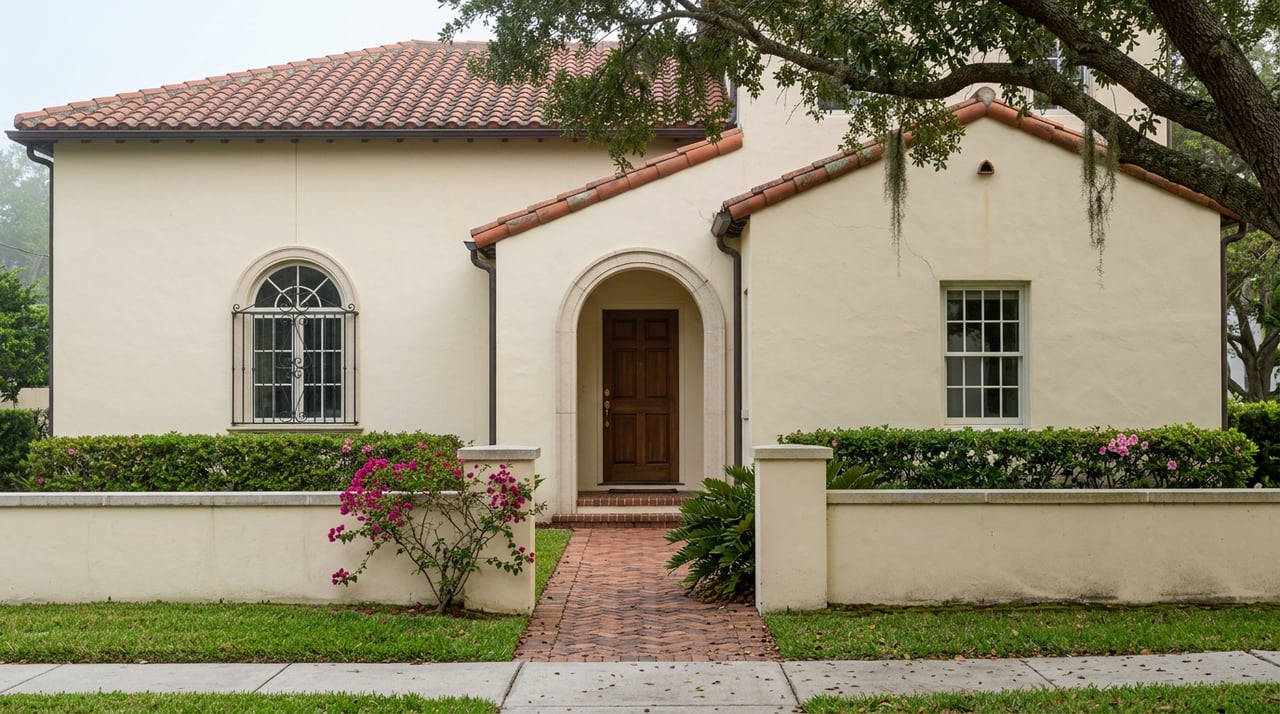
Not Every "Historic" Home in Old Northeast Needs the City's Permission
August 13, 2026
August 13, 2026
Ask five people in Historic Old Northeast whether they need city approval to repaint their porch, and you'll get five different answers. Most of them will be wrong, and not in the direction you'd expect. Some homeowners assume the whole neighborhood is locked down by a preservation board that has to sign off on every exterior change. Others assume the opposite, that "historic district" is mostly a name on a sign, and skip a review step their block actually requires. Both mistakes cost people time or money during a sale, and the fix is knowing which kind of "historic" your specific address carries.
Here's the distinction that gets missed: Old Northeast sits entirely inside the North Shore Historic District, listed on the National Register of Historic Places on February 20, 2003. That listing covers 2,975 historic buildings across the neighborhood, according to the National Register documentation on Wikipedia. But for a residential property, National Register status is largely honorary. It doesn't require design review, and it doesn't require a Certificate of Appropriateness before you touch your own exterior. What actually triggers city review is a separate, much smaller layer: local designation, which applies to only a fraction of the same footprint.
The confusion makes sense because the city uses "historic" for both layers, and most real estate conversations don't separate them. Here's what each one actually does.
| Layer | What it is | Requires a Certificate of Appropriateness? | Applies to |
|---|---|---|---|
| National Register (North Shore Historic District) | Federal recognition, effective 2003 | No, for private residential work | Nearly all of Old Northeast |
| Local designation | City ordinance-level protection reviewed by the Community Planning and Preservation Commission | Yes, for street-visible exterior changes | Granada Terrace Local Historic District, a small number of individually designated one-block districts, and 10 individual local landmarks |
The city's Historic Preservation Office administers the Certificate of Appropriateness program directly, and its own language is precise on this point: local landmark designation gives a property "a degree of protection from unnecessary demolition or unsympathetic alterations," a level of oversight the National Register listing does not carry for residential structures (stpete.org). Preserve the 'Burg, the nonprofit that works alongside the city on these programs, states it just as plainly: national designation is "primarily honorary" for homeowners, while local designation brings actual city review of demolition, new construction, and significant exterior alteration (Preserve the 'Burg).
Roser Park became the city's first local historic district back in 1987, and as of that program's most recent public accounting in March 2020, St. Petersburg had eight local districts against five National Register districts, a gap that tells you how much smaller the regulated footprint really is compared to the honorary one (Preserve the 'Burg).
Inside Old Northeast, that regulated footprint is Granada Terrace, a handful of newly designated one-block districts, and ten individual local landmarks. The Old Northeast Neighborhood Association's own list of those landmarks includes the Vinoy Park Hotel at 501 5th Avenue NE, the Jones-Laughner Residence at 556 Beach Drive NE, the Robert West House (known locally as the Pineapple House) at 101 6th Avenue NE, and Sunken Gardens at 1825 4th Street N (HONNA). If your address isn't one of these and isn't inside Granada Terrace, your exterior work almost certainly doesn't route through a COA hearing at all.
If your property does fall inside a locally designated area, the timeline math matters for anyone planning to freshen up a house before it goes on the market. A standard residential permit in St. Petersburg runs 2 to 5 weeks from submission to issuance. A Certificate of Appropriateness adds roughly 2 to 4 months on top of that, according to contractors who work in these districts regularly, because the application has to pass through the Community Planning and Preservation Commission's own meeting schedule before staff or a board can act on it.
The upside is that approval itself isn't the obstacle. The Old Northeast Neighborhood Association notes that 97 percent of COA applications have been approved since the historic preservation program began in 1987 (HONNA). The friction isn't the city saying no. It's the calendar. A seller who wants new windows installed before listing, and whose home sits in Granada Terrace, needs to build that 2 to 4 month buffer into the pre-listing schedule, not discover it after the contract is already signed with a buyer expecting a quick close.
And the exemption that surprises people most: interior work is not reviewed at all, even inside a locally designated property. Kitchen and bath remodels, electrical panel upgrades, plumbing replacement, none of it needs a COA. Only changes visible from the street, additions, rooflines, siding, and window material do. A seller updating a kitchen ahead of listing photos can move on their own timeline no matter which side of the designation line their house falls on.
One protection does apply neighborhood-wide, regardless of whether your block is locally designated. St. Petersburg began paving its streets with brick around 1903, and in 1992 the City Council passed a resolution protecting brick streets and their granite curbs from removal, a rule now codified under City Code Section 16.40.130 and applied within every National Register and local historic district in the city (stpete.org). Since the entire North Shore Historic District carries National Register status, that protection reaches every brick street in Old Northeast, whether or not the house next to it is individually landmarked.
Hex-block sidewalks, in use in St. Petersburg since about 1914, get similar treatment, and the city has even created standalone overlay districts to protect them where a property sits outside a formal historic boundary, as it did with the Old Southeast Hexagon Block Preservation District. It's a reminder that "protected" and "locally designated" aren't always the same category, and a seller doing due diligence on a driveway or curb cut should check both.
Regulation isn't actually where most Old Northeast sales run into trouble. Insurance and inspection findings are. Every home in the neighborhood built before 1960 has cast iron drain lines, and most insurance carriers in Florida will not write a policy on a home with active knob-and-tube wiring, the ceramic-knob wiring system common in homes built before 1940. It isn't automatically dangerous, but a century of splices, extensions, and overloaded circuits usually means it no longer meets what an underwriter wants to see. Replacing it typically runs $5,000 to $10,000 depending on the home's size, and carrying it forward instead can cost 50 to 100 percent more per year in premiums, according to insurance-industry reporting on older homes (Insure.com). Lenders and insurers frequently ask for a four-point inspection on properties this age, covering electrical, plumbing, HVAC, and roofing specifically, and that report can surface issues that have nothing to do with historic designation but everything to do with whether a buyer's financing clears on schedule.
Florida law also requires sellers to disclose known material defects that a buyer wouldn't discover through a routine inspection. Documenting system ages, prior repairs, and permit history before listing does more to keep a closing on track than any exterior review process does.
There's a genuine upside to local designation that rarely comes up until after a sale closes. Florida law allows cities to adopt ad valorem tax exemptions for qualifying historic rehabilitation, and St. Petersburg has used a 10-year property tax freeze for owners who maintain historical accuracy and preserve specified materials during a renovation. It's the kind of detail that can make a locally designated property with recent, compliant work more attractive to a buyer weighing carrying costs, not less. Preserve the 'Burg held a Restoration & Design Expo downtown this spring, pairing homeowners with contractors who specialize in this kind of work, a sign of how much local demand exists for getting this part right the first time.
Does National Register status by itself require a Certificate of Appropriateness? No. For residential properties, National Register listing is honorary and doesn't trigger design review. Only locally designated properties and districts require a COA for exterior work.
If I just want to repaint my house, do I need approval? Routine maintenance, including repainting in an existing color scheme, generally doesn't require a COA even in a locally designated area. Significant exterior changes are what trigger review.
Does a roof replacement need city sign-off? If your property is locally designated, a roof material or profile change visible from the street can require a COA. Like-for-like replacement generally doesn't. If your home carries only the National Register designation, standard building permits apply without historic design review.
Why does my insurer want a four-point inspection on a house this old? Insurers use four-point inspections on older homes to check electrical, plumbing, HVAC, and roofing condition before writing or renewing a policy, separate from and unrelated to any historic preservation review.
Whether your Old Northeast address sits inside Granada Terrace or simply carries the neighborhood's honorary National Register status, the pre-listing math looks different depending on which one it is. If you're weighing timing on a project before you list, or want a clear read on what your specific block requires, Shirley Rigo has spent decades working these streets and can help you sort out what actually applies before you spend a season guessing. Let's Connect.
Stay up to date on the latest real estate trends.
Experience personalized service, local insight, and a results-driven approach backed by more than four decades of success in the St. Petersburg market.
SHIRLEY RIGO, PA
235 7TH AVE NE ST PETERSBURG, FL 33701